Making Everyday Water Better: A Practical Guide to Home Water Treatment

Water is one of those things most of us barely think about until something tastes strange, leaves a stubborn mark on the sink, or starts making the shower feel less pleasant. We turn on the tap, fill a glass, and expect the water to be clean, safe, and refreshing. When it isn’t, even small problems can become surprisingly frustrating.
That’s where residential water treatment can make a real difference. The right system isn’t simply about making water taste better. Depending on what’s actually present in your supply, treatment can help reduce unwanted minerals, sediments, chemicals, and other contaminants while making everyday water more comfortable to use.
But there’s no universal solution. Your water source, plumbing, household size, and local water quality all matter. Before buying a system because it happens to be popular, it’s worth understanding what your water actually needs.
Start by Understanding Your Water
Municipal water and private well water can have very different characteristics. City water is generally treated before it reaches your home, but that doesn’t mean it will taste or behave exactly the way you want. Older plumbing, disinfectants, sediment, and naturally occurring minerals can all influence water quality.
Well water has its own challenges. Depending on the area, it may contain iron, manganese, sulfur compounds, sediment, or minerals that affect taste, staining, and plumbing performance.
A basic water test is often the smartest first step. It gives you something concrete to work with rather than relying on guesswork. You may discover that your water has one obvious issue, or you may find a combination of problems that requires a more tailored approach.
Why Hard Water Can Be Such a Nuisance
If you’ve ever noticed white spots on faucets, cloudy glassware, or soap that refuses to rinse away properly, you may be dealing with hard water.
Hard water contains elevated levels of minerals, particularly calcium and magnesium. These minerals aren’t generally considered dangerous at typical household concentrations, but they can certainly make domestic chores more difficult.
Over time, mineral deposits can build up inside pipes, fixtures, water heaters, showerheads, and appliances. That buildup may reduce efficiency and create another maintenance headache. Your water heater, for instance, may have to work harder when mineral scale accumulates inside the tank.
A water softener is commonly used to address hardness. Traditional systems exchange calcium and magnesium ions for sodium or potassium ions. Salt-free conditioning systems are another option, although they work differently and shouldn’t automatically be considered equivalent to conventional softeners.
The important thing is matching the technology to the actual problem.
When Filtration Makes Sense
Not every water concern calls for a whole-house treatment system. Sometimes the issue is limited to drinking and cooking water, making a point-of-use filter a more practical choice.
Activated carbon filtration is widely used for reducing chlorine and certain organic compounds. Sediment filters can capture particles such as sand, dirt, and rust. Reverse osmosis systems, meanwhile, can provide more extensive filtration for drinking water by reducing a broad range of dissolved substances.
The trick is not to assume that “more filtration” automatically means “better water.” Every filter has a purpose, and every system has limitations.
For example, a sediment filter isn’t designed to solve dissolved mineral problems. A carbon filter won’t soften water. Reverse osmosis can be highly effective for certain applications, but it produces reject water and requires filter and membrane maintenance.
Good treatment starts with identifying the problem, then choosing the appropriate tool.
Dealing With Chlorine Taste and Odor
For people using treated municipal water, one of the most noticeable complaints is often the chlorine taste & odor that can be present in tap water.
Chlorine and related disinfectants are used to help control harmful microorganisms in public water supplies. Their presence serves an important purpose, but some households don’t enjoy the taste or smell.
Carbon filtration is commonly used to reduce chlorine and improve the sensory quality of drinking water. A simple under-sink filter may be enough if your main concern is the water you drink. If you want treated water throughout the home, a whole-house carbon system may be worth considering.
Again, testing and understanding the water supply should come before choosing equipment. You don’t necessarily need an elaborate system just because one is available.
Whole-Home Treatment vs. Drinking Water Filters
This is one of the biggest decisions homeowners face.
A whole-home system treats water as it enters the property, meaning showers, laundry, kitchen faucets, and other fixtures can benefit from treatment. This approach can be useful when the issue affects the entire household, such as hardness, sediment, or chlorine.
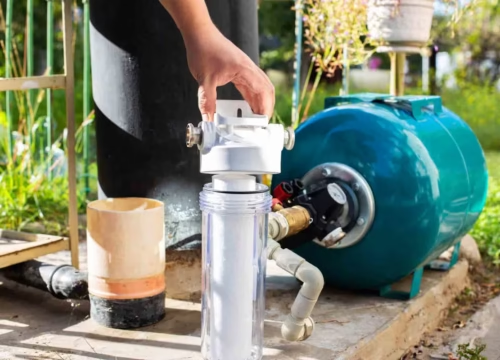
Point-of-use filtration takes a more targeted approach. An under-sink system or countertop filter focuses primarily on drinking and cooking water. It can be less expensive and easier to maintain, particularly when the rest of the home’s water doesn’t need extensive treatment.
Neither option is automatically better. Think about where the problem occurs and how much water needs to be treated.
Maintenance Matters More Than People Think
Even a high-quality treatment system won’t perform indefinitely without care.
Filters eventually become saturated. Softener systems need appropriate servicing and, depending on the design, salt replenishment. Reverse osmosis membranes need replacement according to usage and water conditions. Storage tanks and housings should also be inspected and cleaned as recommended.
Ignoring maintenance can do more than reduce performance. A neglected filter can become ineffective, while clogged components may reduce water flow and put unnecessary strain on the system.
It’s a bit like changing the oil in a car. The equipment may continue running for a while when maintenance is ignored, but that doesn’t mean everything is working as it should.
Choose Treatment Based on Evidence, Not Hype
Water treatment can get confusing quickly. One product promises sparkling water, another claims to solve every possible contaminant, and a third says you need a complicated setup immediately.
Take a breath.
Look at your water test results. Consider your home’s plumbing, water source, daily consumption, and budget. Then compare technologies based on what they are actually designed to do.
If you’re unsure, a qualified water-treatment professional can help interpret test results and explain which options make sense. A good professional shouldn’t push the biggest system available. They should help you understand the problem first.
Better Water Starts With the Right Question
There isn’t one perfect water treatment system for every household. What works beautifully in one home might be unnecessary—or ineffective—in another.
The best approach is surprisingly simple: test your water, identify the specific concerns, understand your treatment options, and choose equipment that addresses those concerns without adding complexity you don’t need.
After all, the goal isn’t to turn your home into a laboratory. It’s to make the water coming from your taps cleaner, more pleasant, and better suited to everyday life. And when you get that balance right, you may notice something wonderful: you stop thinking about your water quite so much. It simply works.