A Practical Way to Think About Better Water Throughout Your Home

Water has a funny way of becoming invisible in our daily lives. We turn on the faucet, fill a glass, start the washing machine, and move on. It’s only when something changes that we suddenly pay attention.
Maybe there’s a chalky ring around the shower drain. Your soap doesn’t seem to rinse properly. The coffee tastes slightly different, or the kettle is collecting scale faster than it used to. None of these things should automatically cause alarm, but they can be signs that your home’s water deserves a closer look.
Improving household water isn’t necessarily about buying the most expensive equipment or building an elaborate treatment setup. It starts with understanding what’s in your water, what problems you’re actually experiencing, and which solutions fit your household.
Hard Water Can Affect Everyday Life
Hard water is common in many areas and is largely associated with dissolved minerals such as calcium and magnesium. These minerals aren’t usually visible when you pour a glass of water, but their effects can become obvious around the house.
You might see white deposits on faucets, shower screens, and appliances. Soap may produce less lather, while dishes can come out of the dishwasher with spots or a cloudy film. Over time, mineral buildup can also affect water-using appliances.
For households dealing primarily with hardness, water softeners can help reduce the concentration of hardness minerals entering the home’s plumbing. A properly sized system can make cleaning easier, reduce scale, and improve the everyday feel of water.
But sizing matters. A system that’s too small may struggle to keep up with demand, while one that’s much larger than necessary may simply add unnecessary expense.
Look at the Whole Plumbing System
Many people focus on drinking water because that’s the water they think about most. Yet the same supply is running through showers, washing machines, water heaters, dishwashers, and bathroom fixtures.
If sediment or other unwanted substances are present throughout the supply, treating just one faucet won’t necessarily solve the larger issue.
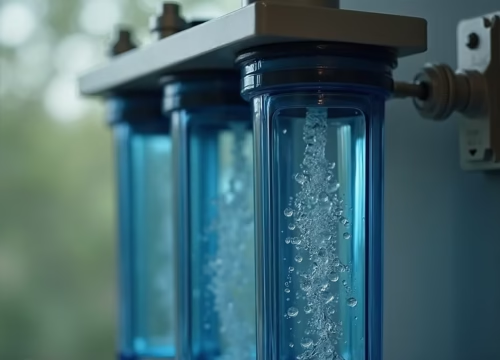
That’s where whole house filtration systems can become useful. Installed at the point where water enters the property, these systems can provide treated water throughout the home rather than limiting filtration to one drinking-water tap.
The type of filtration still matters, though. Different media are designed for different concerns. A sediment filter may capture suspended particles, while carbon filtration is often used for taste and odor improvement. Other treatment technologies address specific water-quality conditions.
The goal isn’t simply to filter everything imaginable. It’s to choose filtration that makes sense for the actual water coming into your home.
Start With a Water Test
A water test may not be the most exciting item on a homeowner’s to-do list, but it can save plenty of guesswork.
Taste and appearance provide useful clues, but they don’t tell the entire story. Some dissolved substances have little or no visible effect on water. Testing can provide a clearer picture of hardness, pH, iron, sediment, and other characteristics depending on the type of analysis performed.
For private wells, testing can be particularly important because water characteristics can vary based on local groundwater conditions.
Once you know what’s actually present, it becomes much easier to decide whether you need filtration, softening, purification, or perhaps no major treatment at all.
That last possibility is worth mentioning. Sometimes the best solution is not to buy another piece of equipment.
Drinking Water Has Its Own Priorities
Water used for bathing and laundry doesn’t necessarily need to be treated in exactly the same way as water intended for drinking.
Homeowners who want additional purification at the kitchen faucet may consider drinking water systems designed for point-of-use treatment. Depending on the technology, these systems can improve taste, reduce certain dissolved substances, or provide another level of filtration.
Reverse osmosis is one example. It uses a semipermeable membrane and additional filtration stages to reduce many dissolved contaminants. It can be an excellent option in the right circumstances, but it also requires maintenance and produces some wastewater.
Again, the water test should help guide the decision.
A drinking-water system should solve a genuine concern, not simply be installed because the equipment looks impressive in a showroom.
Consider What Your Household Actually Needs
A two-person household with moderate water use doesn’t have the same requirements as a family of six with several bathrooms.
Daily water consumption affects equipment sizing. So does the number of fixtures, peak usage, and the characteristics of the incoming supply.
Think about your morning routine. If everyone showers, someone runs the dishwasher, and another person starts laundry within the same hour, the treatment system needs to handle that demand without creating unnecessary pressure or flow problems.
This is one reason professional sizing can be helpful.
Choosing a system based solely on a product’s maximum capacity can be misleading. Real-world household demand is what matters.
Don’t Ignore the Water Heater
Water quality and water heating are more connected than many homeowners realize.
Hard water can contribute to mineral buildup inside storage water heaters. Sediment can collect at the bottom of a tank, potentially reducing efficiency and contributing to premature wear.
Regular maintenance can help. Depending on the equipment, this might include flushing the tank, checking valves, inspecting connections, or evaluating heating components.
If your water heater is making unusual popping or rumbling noises, delivering inconsistent temperatures, or showing signs of leakage, don’t wait indefinitely for the problem to disappear. It probably won’t.
Maintenance Makes the Difference
Installing a treatment system is only the beginning.
Filters need replacement. Softener components need attention. Reverse osmosis membranes eventually wear out. Connections and settings may need inspection. A neglected system can gradually lose performance even though it still appears to be operating.
Before buying anything, ask about the maintenance schedule.
How often do filters need changing? What does routine service cost? Are replacement parts easy to obtain? Does the manufacturer recommend professional inspections?
These practical details aren’t as exciting as the installation itself, but they matter over five or ten years.
Avoid the “More Is Better” Trap
It’s easy to assume that adding more filtration stages must produce better water. That’s not necessarily true.
Every additional component can add maintenance, cost, pressure loss, or complexity. If a particular stage doesn’t address a known water-quality issue, it may provide little practical value.
Good treatment is targeted treatment.
A professional should be able to explain why each major component is included and what it is designed to accomplish. If the explanation is vague, that’s a reason to ask more questions before signing anything.
Better Water Is About Fit, Not Flash
There isn’t one perfect water treatment system for every home.
Some households primarily need hardness control. Others have concerns about sediment, taste, odor, or specific contaminants. Some may benefit from whole-home treatment combined with dedicated drinking-water filtration.
The smartest approach is fairly simple: test the water, understand your household’s needs, consider your budget and available space, and choose equipment accordingly.
Good water treatment shouldn’t feel like a complicated science project. It should quietly make everyday life easier.
When the right system is properly sized and maintained, you may notice cleaner fixtures, better-tasting water, fewer scale problems, and less frustration around the house. And perhaps that’s the best measure of success — not how impressive the equipment looks, but how little you have to think about it once it’s doing its job.