Why Commercial Water Softening Matters for Modern Businesses
Water plays a bigger role in commercial spaces than most people realize. From hotels and restaurants to laundries, offices, healthcare facilities, and manufacturing sites, countless daily operations depend on a reliable water supply. When that water contains high levels of calcium and magnesium, the effects can quietly spread across equipment, plumbing, cleaning routines, and maintenance budgets.
Hard water isn’t always an emergency. That’s part of the problem. It can slowly create scale, reduce efficiency, and make ordinary maintenance more demanding. By the time a business notices the full impact, the cost of ignoring it may already be significant.
Understanding Hard Water in Commercial Properties
Hard water contains dissolved minerals, mainly calcium and magnesium. When heated or left to evaporate, these minerals can form deposits on surfaces and inside equipment.
In a home, this might mean spots on a shower door or scale around a faucet. In a commercial property, the consequences can be much larger because water is often used at a much higher volume.
Boilers, water heaters, dishwashers, laundry machines, cooling equipment, and other fixtures can all be affected by mineral buildup. Even small deposits can interfere with heat transfer or water flow over time. It’s not dramatic on day one, but months and years of accumulation can tell a different story.
Why Commercial Water Softeners Are Different
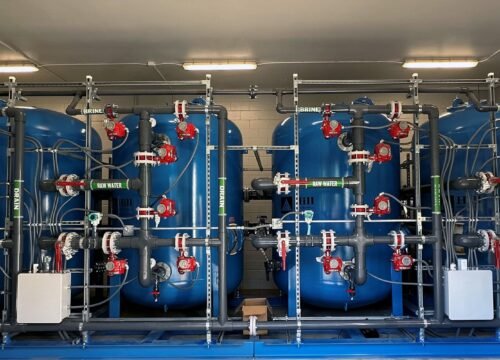
Businesses often have different water demands than residential properties. A small office might use relatively little water, while a hotel, restaurant, or industrial facility may depend on thousands of gallons throughout a normal operating period.
That’s where commercial water softeners become relevant. These systems are designed to handle larger water volumes and more demanding usage patterns than typical residential units.
Sizing is particularly important. A system that works well for one business may be completely unsuitable for another. Water hardness, peak flow rate, daily consumption, available installation space, and the number of fixtures all need to be considered.
Choosing equipment based only on the size of the building can be misleading. A better approach is to look at how the property actually uses water.
The Business Benefits of Reduced Scale
One of the biggest reasons companies consider softening is to reduce scale formation. Mineral deposits can build up inside pipes and equipment, potentially restricting flow and reducing efficiency.
In water-heating equipment, scale can act as an insulating layer. That can make it harder for heat to transfer effectively, forcing equipment to work harder to achieve the desired temperature.
The effect may also be visible in cleaning operations. Restaurants and hospitality businesses can spend considerable time dealing with mineral spots on dishes, fixtures, and glassware. Reducing hardness can make those tasks easier, although the exact results depend on the rest of the water-treatment setup.
Choosing Commercial-Grade Water Softening
A commercial facility needs equipment that can handle its real workload. Commercial-grade water softening typically involves systems built for higher flow rates, greater capacity, and more demanding operating conditions.
But bigger isn’t automatically better. Oversizing a system can create unnecessary expenses, while undersizing may lead to inadequate treatment during periods of heavy demand.
It’s worth working with a qualified water-treatment professional to assess the property’s water characteristics and usage. They can help determine appropriate capacity and regeneration requirements instead of relying on guesswork.
Looking Beyond the Initial Purchase Price
Budget discussions often focus heavily on the equipment’s purchase price. That’s understandable, especially when a business is trying to control spending. But the initial cost is only one part of the equation.
Installation, maintenance, salt or other treatment materials, water consumption, electricity, replacement components, and servicing can all affect the long-term financial picture.
This is why businesses should consider operating costs when comparing systems. A unit with a higher upfront price might potentially be a better investment if it operates efficiently and requires less frequent servicing.
The goal isn’t simply to find the cheapest system. It’s to find a system that delivers reliable performance without creating unnecessary expenses year after year.
Maintenance Keeps Commercial Systems Reliable
Commercial water equipment generally can’t be installed and forgotten. Regular maintenance helps keep performance consistent and can provide an opportunity to identify problems before they become major interruptions.
Businesses should follow the manufacturer’s recommended service schedule and keep records of maintenance work. Depending on the system, this may include checking valves, cleaning components, monitoring salt levels, inspecting connections, and reviewing regeneration performance.
Maintenance records can also be useful for facility managers. When something changes, having a history of previous service makes troubleshooting much easier.
Water Quality Testing Comes First
Before investing in a softening system, test the water. It sounds obvious, but it’s an important step that can sometimes get skipped when a business is eager to solve a visible problem.
Testing can help determine hardness levels and identify other water-quality characteristics that may require attention. In some cases, hardness isn’t the only concern. Sediment, chlorine, iron, or other substances may require additional treatment technologies.
A softener should be selected based on the actual water conditions, not simply because another business uses one.
A Practical Long-Term Investment
For businesses that rely heavily on water, controlling hardness can be more than a convenience. It can support equipment performance, simplify cleaning, and potentially reduce some maintenance demands associated with mineral scale.
The smartest approach is to look at the entire picture: water quality, usage patterns, equipment requirements, maintenance, and long-term expenses.
There isn’t one perfect system for every commercial property. A restaurant, hotel, manufacturing facility, and office building all have different priorities. But when the system is properly sized, correctly installed, and maintained consistently, commercial water softening can become a quiet but valuable part of facility management.
After all, good water management isn’t about having the biggest piece of equipment in the building. It’s about making sure the water works with your business rather than slowly working against it.